

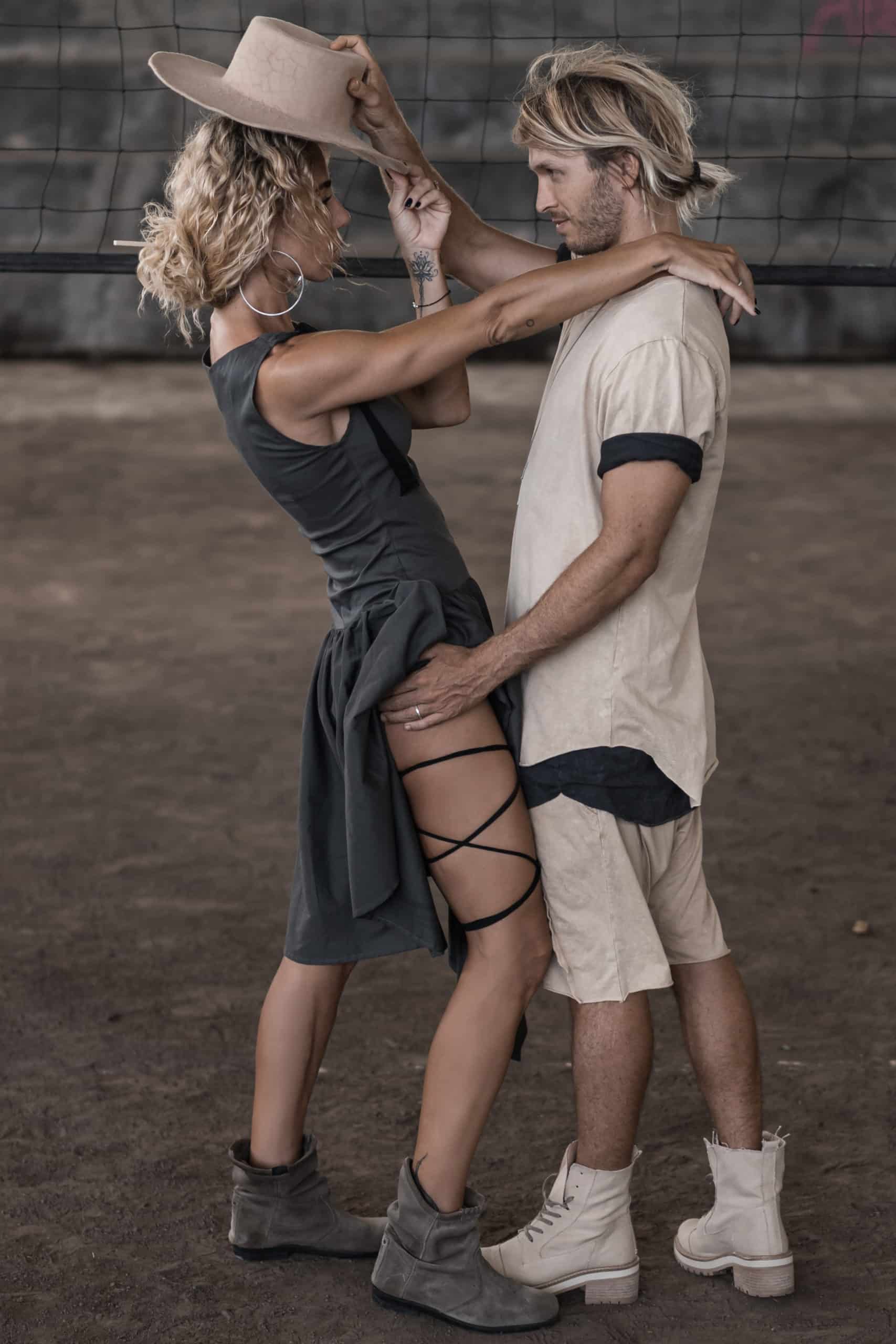
Curlyhouse is clothing for those who see beauty beyond the frozen art of picture galleries, in the daily creativity of creating their own life.
Beauty is a state of inner freedom. You can run into the ocean with a board, where a wave of adrenaline will engulf you, you can breathe slowly in unison with the tranquility of majestic mountains, you can manage to do a thousand things in a metropolis, and then celebrate life with a glass of sparkling champagne amidst the glowing masquerade of a music festival. These are such different states, but it’s all you. You are the intersection of all the roads you walk, the palette of emotions that make up the picture of life.
Curlyhouse clothing is the same. Drawing inspiration from the history of art, fashion, and philosophy, I create chameleon collections, intertwining urban practicality with extravagance, combining the rigor of a hussar’s tailcoat with Kurt Cobain’s grunge. Clothing-game that inspires to break out of the cage of stereotypes and be different, yourself, as you want. Unique and multifaceted. Free to laugh sincerely, make love, and be happy.
Who is Maria Belikova?
– The creator of the Curlyhouse brand, how would you define yourself?
I am an artist, creator, someone who generates ideas and dreams. A person who inspires and motivates others to become happier, more confident, someone who can give a good mood and faith in goodness and beauty.
– And what do you believe in?
I believe in the power of my thought. The best rule is the one you made up yourself. Generally accepted signs and omens were once invented by someone, and I want to be the mistress of my life, so I create my own omens. For example, if you find money on the road, you need to pick it up and give it to those in need or spend it on someone. My omen means that what came to me easily will easily go to someone else’s benefit, and I will earn even more.
– What is the most beautiful thing you have seen in this world?
There is a lot of beauty around us. But beauty is a much broader concept than appearance. There is physical beauty, and there is ephemeral beauty – these are people’s actions. For me, the most beautiful thing in this world is my husband. Not just because he is externally handsome. Also, his attitude to life and to me is incredibly beautiful. This is what inspires me.
– Are you always in a good mood?
Like any person, I have different periods, and since I am an artist, I have terrible ups and downs of inspiration and mood, but I am still happy. I choose to be happy and inspire people by my example.
– What do you put into the concept of happiness?
Acceptance of life situations as they are at the moment. Not apathy, but inner agreement with oneself and the world, without boredom, without regret, but also without a gigantic desire for something other than what is.
I have gone through Vipassana several times – it is a 10-day course of meditations, during which you cannot talk, use gadgets, or even look into other people’s eyes. There you come face to face with what is really in your head. I myself am constantly in a borderline state: I love my life, but at the same time, there is always a desire to change something. I simply accept this state as a given, it is a trait of my character. By accepting myself, I become happy.
– How do you manage to do this?
Persistence, kindness, and selective memory. I remember good events and let go of the bad ones.
– And what would you like to learn?
To stop in time. I am a holiday person, I can dance for eight hours, I can walk or surf, or snowboard until I drop. And the same with work, I don’t notice time, forget to eat and sleep. In the moment, I don’t want to stop, but the lack of moderation takes away a ton of energy. If you party, work, or ride to the end, then you have to spend time recovering.
Responsibility helps me. When you have to do something “you have to,” but you don’t want to, I remember that I am responsible for the salaries and good life of the people who work for me. And this works better than any motivation – you take and do it.
About Production
– Let us take a look behind the scenes, how is Curlyhouse clothing born?
First comes the idea. For example: to combine deconstruction, baroque, and grunge. I develop an entire collection, 20-30 models, all the images and their combinations with each other at once. The creative process and creation are what I started sewing clothes for. It fascinates me.
Before, I used to make all the clothing patterns myself. Now I don’t have time to both manage the organization and make the patterns, so I delegate half of it to a designer. I draw a sketch, describe how and what should be. Or I draw on the fabric myself, cut it, sew it, and give it to the designer to make the pattern. I usually look for fabric to match the model, not the other way around. Each fabric has its own characteristics, and I don’t like to adapt to them; it limits me. If there is no specific fabric, we look for a replacement. Quality is the main thing.
Then the collection is sent for sewing, and the factory sews one model after another in stages. As soon as each model is sewn and delivered, it immediately appears on the website. I don’t wait for the factory to sew all the items to announce the collection; as soon as an item is ready, it can come to life.
– Do you plan collections or act more on inspiration?
I recently took a “Can you build your own clothing brand” test on some website for fun. I failed it. There were questions like, “If you like a fabric in the store, will you buy it right away or check with the plan and calculate the budget?” I will buy, make, create. There is inspiration, there is demand – I sew and don’t keep track of the fabric that goes into developing models, into creativity. I think it’s miles per month.
The test result was – no, you still need to learn how to build a fashion business brand. And my result – all the things that I created on a whim of desire and inspiration brought me success, recognition, and money. This is, of course, not a universal scheme; everyone has their own method and intuition, and any way can lead to success.
– You often ask for subscribers’ opinions on one model or another in stories. Do you really take the answers into account?
Of course! I rely on feedback; people who choose Curlyhouse items are very important to me. It’s so cool, as if I have a huge team. I like to hear and listen to people’s opinions.
The models that 100% like, I launch; those that don’t, I sometimes reject. On the one hand, imposter syndrome makes me doubt my creativity. But sometimes I understand that as an artist, a person with a ton of knowledge in art history and fashion, I can explain this model, show how to wear it, and despite the “no,” I launch it for sewing.
But many factors are involved here. I’m interested in what people need. Whether they like it or not. And of course, I can’t create an item that people don’t understand; they won’t buy it, and that’s frozen money. I’m not just an artist; I also calculate the cost of fabric, sewing, fittings, deliveries, and packaging, add calculations for rent, salaries, taxes, and certificates. Sometimes the cost is huge, and I sell the item almost at that price. My position is to create quality and beautiful items and sell them at an affordable price. That’s why I can’t afford to make items that won’t be bought.
– What are Curlyhouse items like?
I like the “chameleon” philosophy. Items that smoothly blend into any wardrobe and suit different styles. That’s why I mainly use black, white, and gray colors; they are functional, and it’s easier to create an image with them. Color or print complicates, and my items are suitable for people for different situations.
For example, leggings with a skirt. The perfect item. These pants don’t look like leggings. They go great with classics or casual. The elongated legs gather in folds; you can pull them onto the heel or distribute them along the leg, and the upper part – the skirt, covers the front and buttocks, making the item less provocative. They hide figure flaws and give a sense of comfort and confidence. Or a half-glove sleeve on sweaters and dresses, elongated and with a slit, like a cut-off mitten. You can put it on your thumb and make the item’s look underground, or hide it and get a classic sleeve.
And many of my items are “flying,” inspired by the wind. The wind is perfect. It reveals the item, the fabric, the hems. It’s mesmerizing. I don’t skimp on fabric in skirts and hems. In a stable state, they are straight, and when moving, they unfold.
– Which process do you like more: coming up with ideas or bringing them to life?
I love both. But the coolest thing is when people tag me, write thank you, when they wear, recognize, and, of course, buy. This says that what I do is needed by the world. Every artist needs recognition to continue creating.
About the Path
– What did you dream of becoming as a child?
I don’t remember having a dream related to a particular profession. But I always loved to sculpt, draw, invent. At 14, I knew for sure that I wanted to be an artist. Then there were several main art institutions: architectural, printing, textile institutes… And Stroganov University, after graduating from which you became an artist. The choice was obvious.
Honestly. I went to monumental decorative applied art because there was less competition there. And I passed. And I’m super grateful for this education. They gave me a cool academic base and taught me to use my imagination, invent, and create.
– You didn’t become an artist in the classical sense of the word. Why?
In university, I constantly participated in exhibitions and even won a competition from a contemporary art museum. But far from everything we did, I liked. For example, we did a lot of sculpting. And in the fourth year, I realized that I don’t like sculpting. So I just started looking for work in different fields in parallel.
I did all sorts of things – snowboard design, graphics, and installations. I worked in a contemporary art museum: created collages, participated in exhibitions and performances. There I learned that art should be provocative. This draws attention to social issues, world problems, and the soul. Provocation is one of the brightest ways to do this.
But there also came the realization that my paintings and works hang on the museum wall for a couple of weeks and that’s it. Their life for the public ended there. And I wanted to give life to my ideas and make people happy. And in general, to understand contemporary art, you need to read the annotation. I want to create things that are understandable to people, that are beautiful without explanations.
– How did you get into the world of fashion?
I got a job as an assistant to Masha Tsigal. And off it went. The world of fashion captivated me. I was studying full-time, but skipped classes, went to work, then to university. Before the sessions, I urgently wrote paintings, did projects, passed exams. The salary was 5000 a month, but it didn’t matter to me, the main thing was to work, gain experience, and be in a super creative and fashionable sphere.
– Experience is important, of course, but how to start your own business without investment?
My perseverance and hard work helped me. For six years I worked alone and did everything myself. I sewed two hoodies, sold them at the market, and with the money earned, I sewed four. I launched targeted advertising, stars began to tag me and wear my items, the items became more complex, I made a website. That’s how, step by step, the Curlyhouse brand grew and continues to grow without investment.
The same story with the showroom. As soon as sales became stable and grew, there was a desire to open a place where you can touch and try on clothes. My cousin offered to rent a small space from her. In six months, I was able to rent a large showroom. Another two months later, I moved to a large space with my own interior design, with my ideal location.
The team also grew gradually. The first person to whom I delegated part of the tasks – my manager – still works with me. Now I have a team of 12 people, some work in the office and in the showroom, others are outsourced. These are my Curlyhouse angels. Ethics are important to me, so I pay good salaries and make sure that the workload is adequate.
– What’s more important, talent or strategy?
“I am part of that power which eternally wills evil and eternally works good.” This means “there is no good and bad, one is not more important than the other.” A strategist cannot be without talent. Just as a talented artist or musician cannot be without a strategic producer.
I don’t consider myself super talented or an outstanding strategist, I have 50% of both. Not having either fully, I combined what I have. And it turns out the combination gives a good result.
– What is the nearest development goal for the brand?
I want the brand to become more recognizable, for people to know the name Curlyhouse, to know the ideals and principles behind it. I dreamed of getting into fashion media, but many of them are now closed in Russia, so I’m still thinking about how else I can get closer to this goal. I’m thinking about opening a store in St. Petersburg and creating larger model collections.
– And what is the biggest dream? If anything is possible?
To always be healthy and inspired. Then there will be the strength to create and inspire others.